


Nowadays, the problem of visual impairment (the rapid development of various eye diseases) is very acute among people of different age groups.This is all due to neglect of health and excessive stress on the organ of vision.Computers, tablets, phones, televisions and e-books - all these things can not only simplify life, but on the contrary can also cause harm.
Fortunately, science does not stand still and diseases that were previously difficult to treat can now be eliminated with practically no consequences or complications.
Laser vision correction
Laser vision correction is not only a way to do without glasses and contact lenses, but also the only effective and safe way to preserve vision as you age.
The advantages of this procedure:
- Security.Relatively low chance of serious complications occurring.
- Effective in case of any violations.The operation is performed not only to improve vision and get rid of optics.In some cases, laser correction cannot be avoided (this applies to diseases that lead to blindness).
- Painless.Before the procedure begins, an anesthetic is infused into the patient's organ of vision, so that the patient can experience a maximum of mild discomfort at certain stages of the surgical procedure.
- Non-duration.The procedure itself only takes a few minutes, most of the time is spent preparing.
- Short recovery period.In this case, registration at the hospital is not necessary.The procedure is carried out on an outpatient basis and the patient can then go home.
- Stability and predictability.The doctor almost always knows how effective the operation will be before it is carried out.The result lasts for a long time (an exception may be the patient's progressive myopia).
The choice of specialist and location of the operation always remains with the patient.The price of the procedure and medical services in private clinics may vary.Their formation is influenced by many factors.It is therefore worth taking the time to search for information and clarify all questions that interest you in advance.
Operating modes
There are several correction methods.Each of them has its own advantages and disadvantages.List of types of laser correction:
- Laser (subepithelial) keratomileusis;
- photorefractive keratectomy;
- Femtosecond LKZ.
Photorefractive keratectomy (PRK) was first performed in Germany several decades ago.In this procedure, the cornea is exposed to an excimer laser.Indications for the procedure include astigmatism, nearsightedness and farsightedness.
A significant disadvantage of the photorefractive keratectomy method is the long and unpleasant recovery period.In addition, vision does not return immediately after the procedure, but gradually;Complications are possible.Therefore, it is resorted to only when other, more modern and effective methods are contraindicated.
Laser-assisted subepithelial keratomileusis (LASEK).In contrast to the previous method, the operation does not remove the superficial layer of the cornea, but only moves it to the side.The recovery period is shorter than with PRK.
Laser keratomileusis (LASIK).This is currently the safest and most effective method of vision correction.The recovery period is short, vision improves within the first few hours after surgery.
Femtosecond LKZ (Femto-LASIK) is one of the modifications of the LASIK method that helps achieve ideal results.Risks are reduced, vision returns and the rehabilitation period does not last long.This method also has fewer contraindications than traditional laser correction.The procedure can also be performed on patients with dry eye syndrome.
There are also other modifications to the basic methods.The doctor makes the choice of the most suitable method in a particular situation.
Indications and contraindications
Laser vision correction, like any other procedure, has its indications and contraindications.The indications are divided into two types: medical and professional.
A medical indication for laser vision correction is the presence of the following disorders in one eye (the other sees well):
- farsightedness;
- Astigmatism;
- Myopia.
Professional indications (specialties where wearing lenses or glasses is inappropriate):
- firefighters;
- police officers;
- Military;
- People working in the industrial sector (places where there is a lot of dust, smoke and other unfavorable factors).
Contraindications are relative and absolute.The absolutes include:
- autoimmune diseases;
- Immunodeficiency;
- Diseases that affect the healing process and speed after surgery;
- the patient only has one eye;
- myopia (progressive);
- herpes virus infection;
- retinal detachment;
- Thinning of the cornea.
List of relative contraindications:
- diabetes mellitus;
- psychoses;
- pregnancy and breastfeeding;
- the patient has heart problems (presence of a pacemaker);
- eye diseases of an inflammatory nature;
- scars in the cornea (cover);
- Changes in the retina and fundus.
Operation is strictly prohibited for persons under 18 years of age.This is due to physiological characteristics (not fully formed eyeball).
Preparation for laser correction
If an operation to restore vision is already planned, the ophthalmologist recommends passing a series of tests and adhering to certain rules.You may also need to consult other specialists: therapists, endocrinologists, cardiologists, etc.
Tests to be done before the procedure:
- general blood test;
- general urinalysis;
- HIV test;
- test for syphilis;
- hepatitis test;
- Coagulogram.
A list of recommendations that are very important when admitting to surgery:
- Stop wearing contact lenses (this must be done one to two weeks before surgery);
- Avoid alcoholic beverages and medications containing alcohol for a few days before the procedure.
- Get yourself in order before the procedure.
- breakfast on the agreed date should be light;
- You should not apply makeup to your face or perfume to your body before surgery;
- You must purchase and take sunglasses with you (these will be needed after the procedure and during the recovery period);
- When undergoing laser surgery to improve vision, it is advisable to take a loved one with you who will remember all the doctor's recommendations regarding the postoperative period, help you travel home and take care of the patient the first time.
Compliance with these conditions is very important, since the success of the procedure and the final result depend on it.
How is the procedure carried out?
Almost all types of laser correction are performed in 3 main steps.If we talk about the most effective, popular and sought after LASIK procedure, it is as follows:
- First stage.A laser or microkeratome creates a flap on the surface of the cornea and moves it to the side.
- Second stage.The shape of the cornea is changed using a laser beam (it must correspond to the individual parameters of the patient).
- Third stage.The flap is returned to its original position and allowed to heal.
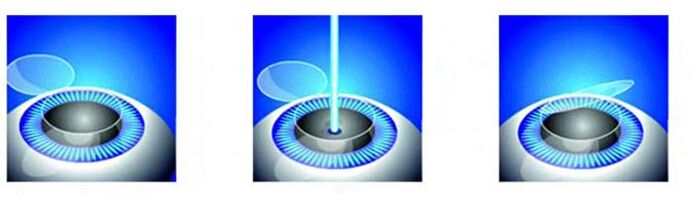
Many people have heard of patients having their eyes taped shut during surgery.The patient may wake up during the procedure and injury is possible.In this situation, laser correction does not seal the eyes, since anesthetic drops are instilled before the procedure, and the operation itself lasts only a few minutes, so such measures are unnecessary.
Postoperative period
The postoperative phase is different for everyone.But after laser correction using LASIK, the patient feels improvement in the first few days and does not experience any major discomfort.
After the operation, it is necessary to once again clarify all possible complications, ask worrying questions and listen to the main recommendations again.
An approximate list of measures in the postoperative period (the duration of this period depends on many factors):
- You can only sleep on your back;
- It is mandatory to visit an ophthalmologist at the prescribed appointments.
- After the operation, it is necessary to wear sunglasses outdoors (they protect against dust, infections and small particles entering the eyes);
- Do not touch the operated area with your hands;
- Prescribed medication must be taken at the right time and in the specified amount;
- It is better not to wash your hair in the first few days after surgery;
- You can only wash with purified or boiled water;
- You should stop using skin care and decorative cosmetics for some time.
- it is important to moderate physical activity for a while (the doctor should inform you about the end of restrictions at the appointment after the examination);
- You are not allowed to visit saunas, swimming pools and other public places where you can become infected.
- it is necessary to reduce eye strain (refusal to read, watch TV, prolonged use of phones and tablets);
- Driving is strictly prohibited during the postoperative period;
- If it becomes painful or severe discomfort occurs, you need to see a specialist.
There are also some nutritional recommendations.Since laser correction is still a surgical procedure and therefore places a certain strain on the body, you need to eat right.
As in any other period, the diet should be healthy and contain the necessary vitamins.To improve vision, it is recommended to eat fruits and vegetables rich in vitamins A and C.
Suitable for:
- Fruits and berries: blueberries, apricots, peaches, kiwi, etc.;
- Vegetables: broccoli, carrots, tomatoes, pumpkin;
- fermented milk products (cottage cheese);
- Fish: salmon, mackerel;
- Meat: chicken, rabbit, turkey;
- offal (kidneys and liver);
- Eggs (yolks).
In the postoperative period, drinking alcohol is strictly prohibited and quitting smoking is recommended.If your health deteriorates sharply in the first weeks after surgery and requires additional medication, you should tell your doctor about the recent laser correction.
Risks and consequences of the operation
Although in principle laser correction does not pose a serious danger, there are still situations in which complications arise and have not entirely pleasant consequences.The ophthalmologist must mention this at the appointment and the patient, if he agrees to the operation, must be prepared for possible risks.
List of possible complications that may occur during surgery:
- the cornea may become cloudy;
- visual acuity may decrease;
- the image may begin to double in size;
- Astigmatism develops.
Such problems can arise for various reasons: lack of experience and professionalism of the doctor, incorrectly selected instruments or correction method, technical reasons, etc.
Complications that may occur after surgery:
- swelling, inflammation, itching, pain and burning;
- allergic reaction to medications;
- no improvement or deterioration;
- Blindness (caused by individual intolerance).
A number of problems that may appear not immediately, but some time after the operation:
- Recurrence of eye diseases (short duration of therapeutic effect);
- dry eye syndrome;
- pathological processes affecting the cornea (keratoconus, erosion, etc.).
The laser correction method has both advantages and disadvantages.The decision to carry out this procedure or not is everyone's business.In some cases, it helps improve the quality of life (allows you to walk without glasses and contact lenses) and sometimes saves from complete blindness.
Surgical operations
Despite the great popularity of laser correction, there are situations in which other microsurgical procedures are simply indispensable.They protect patients with glaucoma, cataracts and various retinal diseases from blindness.And they also have a number of advantages and disadvantages.
To combat cataracts, operations are performed to remove the lens and replace it with a lens.Microsurgery can also be used to treat retinal diseases.To do this, doctors achieve complete adhesion to the tissue (subject) or remove scars and tissue with signs of pathological changes from the vitreous body.Glaucoma is overcome through surgery to restore fluid balance in the organ.
The following procedures (surgical procedures) are also widespread:
- Keratoplasty (this procedure restores the functions and shape of the cornea);
- scleroplasty (a surgery that helps stop progressive myopia);
- Lens (phakic) implantation: farsightedness and myopia are corrected;
- Vitrectomy (this procedure eliminates pathological processes in the retina)
- Lensectomy (the operation involves removing the lens and replacing it with an intraocular lens).
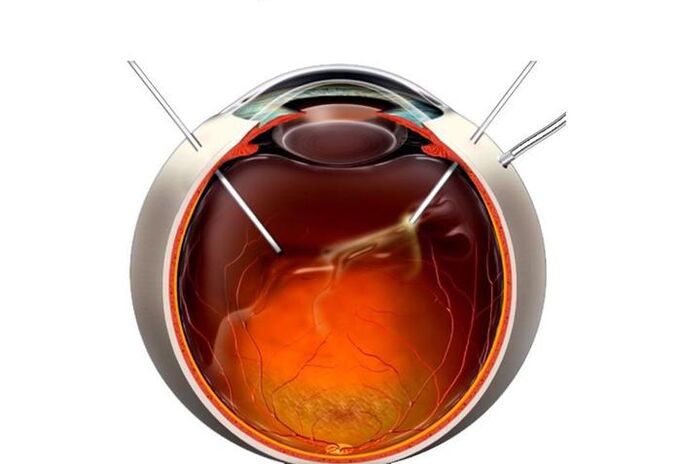
Surgical ophthalmological procedures can be cavitary or superficial.Laser correction is a superficial type while cataract surgery is a cavitary type.
Surgical intervention helps when laser correction is prohibited or a serious eye disease (cataract, glaucoma, etc.) cannot be coped with.Therefore, if the doctor insists on a surgical method of combating the disease, you must trust him.
Treatment for eye diseases is rarely cheap, and this is not due to doctors' desire to make as much money as possible.This is due to the high cost of the material and equipment used for treatment.The eternal question remains the decision for a clinic: private or public.In this case it is difficult to guess.A doctor from a public clinic may have more experience and perform all procedures efficiently and safely, while a doctor from a private clinic may have more conditions for successful work (modern equipment).Some doctors work in a private and public clinic at the same time, so you don't have to focus too much on the price of services.Positive reviews and recommendations are much more important.